


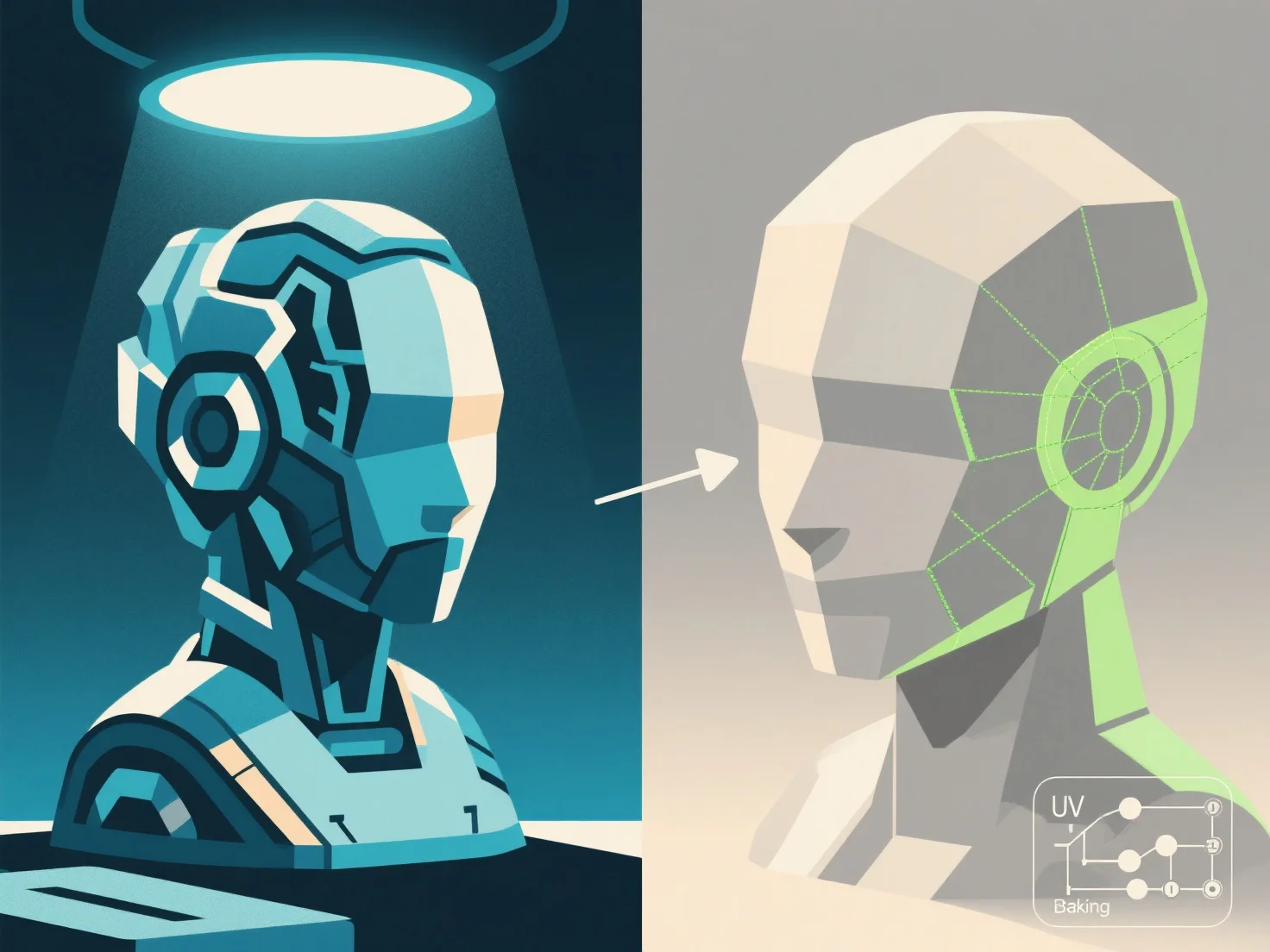
Les textures de cuisson simplifient le flux de travail 3D en consolidant les détails haute-polygonalité en cartes basse-polygonalité, équilibrant ainsi la qualité visuelle et l'efficacité.
- **Transfert de détails** : Transfère les détails de surface (par exemple, bosses, ombres) de modèles complexes à haut niveau de polygones vers des modèles plus simples à faible niveau de polygones via des cartes telles que les normales ou l'occlusion ambiante (AO), préservant le réalisme sans une géométrie lourde. - **Amélioration des performances** : Réduit la taille du fichier et la charge de rendu, ce qui est essentiel pour les applications en temps réel (jeux, AR/VR) et une visualisation 3D efficace. - **Simplification du workflow** : Facilite la manipulation des modèles, accélérant le post-traitement (texturation, rendu) ; les débutants bénéficient en commençant par la cuisson des normales/AO pour optimiser les détails et l'efficacité.
Globalement, les textures de cuisson optimisent le pipeline 3D, rendant les modèles de haute qualité réalisables pour divers projets tout en assurant des flux de travail fluides.