Filmmaking has always been an industry driven by technological leaps, but few innovations have reshaped the cinematic landscape quite like virtual production. For decades, directors and actors relied heavily on green screens, forcing them to perform in empty, brightly lit rooms while trying to imagine the digital worlds that would be added months later in post-production. Today, the convergence of LED volume filmmaking and real-time VFX is completely flipping the script, merging the physical and digital worlds seamlessly on set.
Whether you are a seasoned VFX professional, an indie filmmaker, or a film student, understanding how Unreal Engine film production is replacing traditional workflows is no longer optional—it is essential. In this comprehensive guide, we will explore the mechanics behind this revolution, how leading productions are utilizing the technology, and how you can integrate these cutting-edge workflows into your own creative process.
What is Virtual Production?
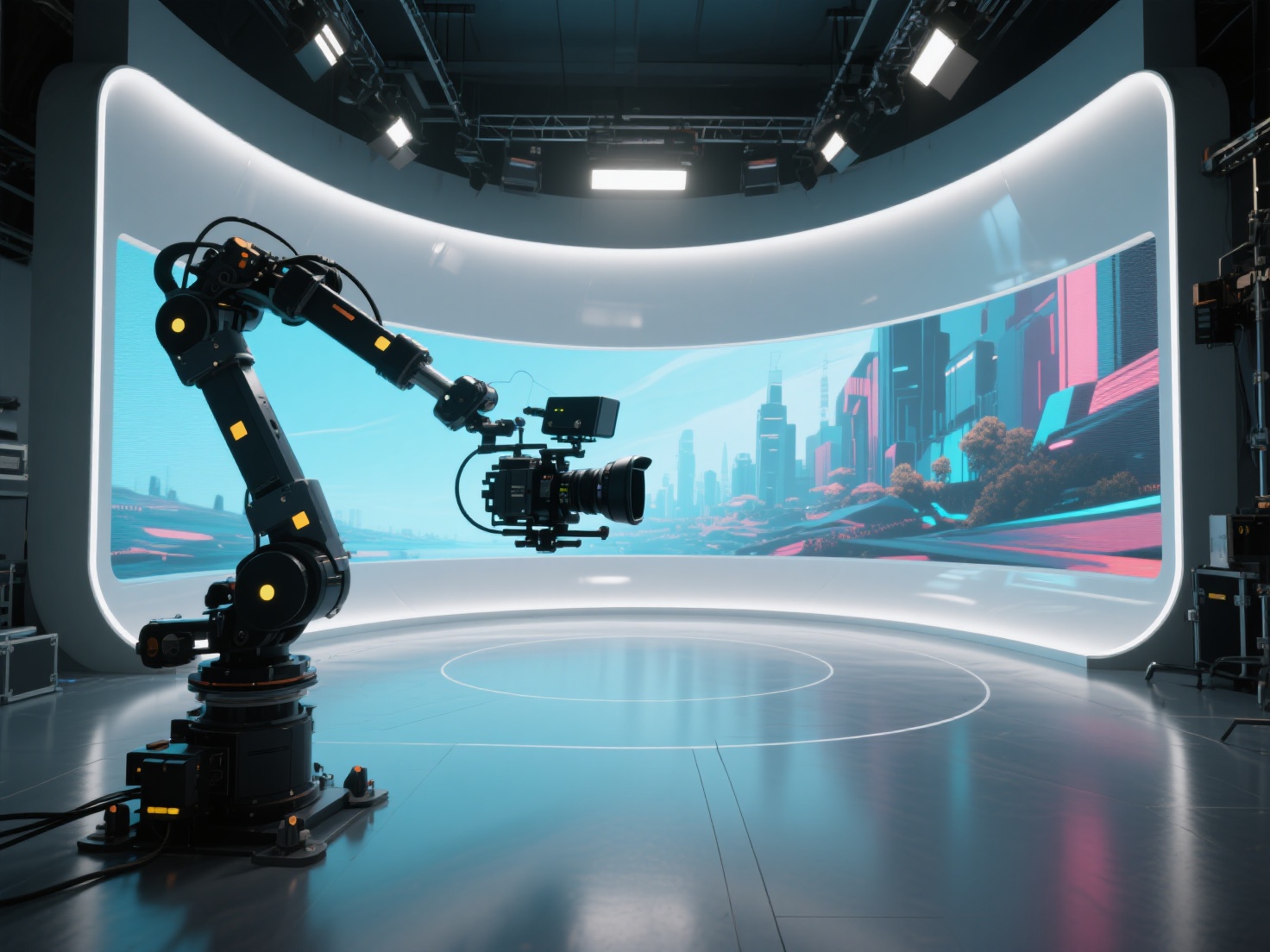
Virtual production is a modern filmmaking methodology that combines physical production techniques with computer-generated imagery (CGI) in real-time, typically utilizing massive, high-resolution LED screens and real-time game engines to display interactive 3D environments behind live-action actors.
By rendering digital worlds on set rather than in post-production, filmmakers can capture final-pixel visual effects entirely in-camera, allowing for highly realistic lighting, immediate creative adjustments, and a deeply immersive environment for the cast and crew.
The Mechanics of LED Volume Filmmaking & Real-Time VFX
To truly appreciate the paradigm shift brought by this technology, we must break down the core components that make real-time VFX possible on a modern soundstage.
The Power of LED Volumes vs. Traditional Green Screen
The traditional green screen workflow comes with significant pain points: “green spill” (where green light bounces onto the actors), the tedious process of rotoscoping and keying, and the inability of actors to see their surroundings.
LED volume filmmaking solves these issues entirely. By surrounding the physical set with towering walls of high-resolution LED panels, the digital environment actually illuminates the physical set. The light emitting from a digital sunset on the LED wall will naturally cast warm, realistic reflections onto an actor’s skin or the shiny surface of a prop car. This creates a level of physical integration that is incredibly difficult and expensive to replicate with a green screen.
Unreal Engine Film Production
At the heart of this revolution is the real-time game engine. Historically used exclusively for video games, software like Epic Games’ Unreal Engine is now the backbone of Unreal Engine film production.
Instead of waiting hours or days for a single frame of CGI to render offline, real-time engines utilize powerful GPUs to render photorealistic 3D environments at 24 frames per second or higher. This means if a director wants to move a digital mountain in the background or change the time of day from noon to twilight, a technician can make the adjustment in the engine, and the LED wall will update instantly.
Camera Tracking and the “Inner Frustum”
Simply putting a video on a screen behind an actor isn’t new—that is called back-projection. What makes modern virtual production magical is camera tracking and In-Camera Visual Effects (ICVFX).
Sensors are attached to the physical cinema camera, tracking its exact position, tilt, and lens focal length in the real physical space. This data is fed into the game engine in real-time. As the physical camera moves, the game engine calculates the exact perspective the camera should be seeing and updates the LED wall accordingly.
This specific rendering area on the screen is called the inner frustum. Because the perspective shifts perfectly in sync with the physical camera, it creates a flawless illusion of 3D depth, known as the parallax effect.
Real-World Applications: Movies and Shows Leading the Charge
The theoretical benefits of real-time VFX are impressive, but the practical applications have already proven to be industry-defining.
The Mandalorian: Pioneering the LED Volume
Lucasfilm’s The Mandalorian was the first major production to prove that LED volume filmmaking could replace location shooting. Using ILM’s StageCraft technology, the crew shot scenes taking place on diverse alien planets, barren deserts, and spaceship interiors—all within the confines of a single soundstage in Los Angeles.
By rendering the Star Wars universe in Unreal Engine, the production saved millions in travel costs and entirely avoided the unpredictable variables of location shooting, such as bad weather or losing natural daylight.
1899 and Adapting Complex Environments
The Netflix series 1899 took the technology a step further by utilizing a massive custom-built LED volume in Germany. The show takes place on an ocean liner in the late 19th century. Shooting on the open ocean is notoriously one of the most difficult and expensive endeavors in filmmaking.
By utilizing virtual production, the team was able to simulate dynamic ocean horizons, rolling fog, and complex lighting scenarios, maintaining total control over the environment while keeping the cast and crew safe and dry on a soundstage.
Best Practices for Adapting to Virtual Production
Transitioning from traditional filmmaking to an Unreal Engine film production workflow requires a fundamental shift in how a production is planned and executed. Here are the best practices for success.
1. Shift Your Mindset to “Fix It in Pre”
In traditional VFX, the mantra is often “we will fix it in post.” In virtual production, you must “fix it in pre.” The Virtual Art Department (VAD) must design, build, and optimize the 3D environments before principal photography begins. If the digital world isn’t ready when the actors step onto the stage, the entire production halts. Meticulous pre-production and storyboarding are absolutely critical.
2. Accelerate 3D Asset Creation with AI
Populating a photorealistic Unreal Engine environment requires thousands of high-quality 3D assets. Modeling these props from scratch can take a VAD team weeks or months. This is where AI-driven pipelines become invaluable for maximizing efficiency.
If your Virtual Art Department needs to quickly turn concept art into production-ready 3D props, Hitem3D is the ultimate solution. As a next-generation AI-powered 3D model generator, Hitem3D transforms simple 2D images into high-fidelity 3D models with clean, print-ready geometry.
Powered by its in-house Sparc3D model, Hitem3D is highly beneficial for real-time VFX workflows because of two distinct differentiators:
- Invisible Parts Reconstruction: It doesn’t just extrude a flat image; the AI intelligently reconstructs the hidden structures of a prop, generating a full 360-degree model with up to 2M polygons (1536³ Pro resolution) that you can drop directly into your scene.
- De-Lighted Textures: This is crucial for LED volume filmmaking. Hitem3D outputs 4K PBR-ready textures while automatically removing baked-in lighting and shadows from the original image. This means when you import the FBX or OBJ into Unreal Engine, the asset will react perfectly to the dynamic lighting of your digital environment, rather than carrying conflicting fake shadows.
3. Start Small and Scale Up
You don’t need a multi-million dollar StageCraft volume to start using this technology. Indie filmmakers and students can build “micro-volumes” using standard green screens combined with real-time camera tracking (using tools like HTC Vive trackers), or by utilizing smaller, affordable LED walls for tight close-ups and car process shots.
The Future of Real-Time VFX in Filmmaking
The era of relying solely on green screens and delayed post-production rendering is coming to an end. Virtual production, powered by LED volume filmmaking and real-time VFX, is empowering creators to see their final vision immediately through the lens. By embracing Unreal Engine film production, filmmakers are unlocking unprecedented creative freedom, reducing logistical headaches, and pushing the boundaries of visual storytelling.
As the demand for immersive, real-time 3D environments continues to grow, the need for rapid, high-quality 3D asset generation is more critical than ever. Don’t let the bottleneck of manual 3D modeling slow down your Virtual Art Department.
Whether you are populating a massive sci-fi cityscape or filling a digital interior with realistic props, Hitem3D offers the geometry and De-Lighted PBR textures you need to bring your virtual sets to life seamlessly. With a completely Free Retry system, you can experiment until you get the perfect asset for your scene.
Ready to accelerate your virtual production workflow with next-gen AI?
Frequently Asked Questions (FAQ)
Q: Is virtual production only for massive blockbuster movies?
A: Not anymore! While pioneered by massive budgets, the technology is democratizing rapidly. Independent studios are building smaller LED volumes tailored for commercials, music videos, and indie films, while software like Unreal Engine remains free to use for creators.
Q: Does LED volume filmmaking completely replace the VFX department?
A: No, it shifts their timeline. Instead of doing the bulk of the work in post-production, VFX artists (now part of the Virtual Art Department) do the heavy lifting in pre-production to build the 3D environments. Post-production is still needed for touch-ups, rig removals, and extending sets beyond the LED wall.
Q: Can I use AI-generated 3D models in Unreal Engine for virtual production?
A: Absolutely. Tools like Hitem3D can generate highly detailed 3D models in formats like FBX and OBJ, which are natively supported by Unreal Engine. Because Hitem3D provides De-Lighted PBR textures, these AI-generated assets will react accurately to the engine’s real-time lighting, making them perfect for populating virtual sets quickly.
Q: What is the biggest challenge of shooting on an LED volume?
A: Moire patterns (a visual artifact caused when a camera’s sensor conflicts with the grid of the LED pixels) and latency. The camera tracking and engine rendering must happen within milliseconds to prevent the digital background from “lagging” behind the physical camera movement.