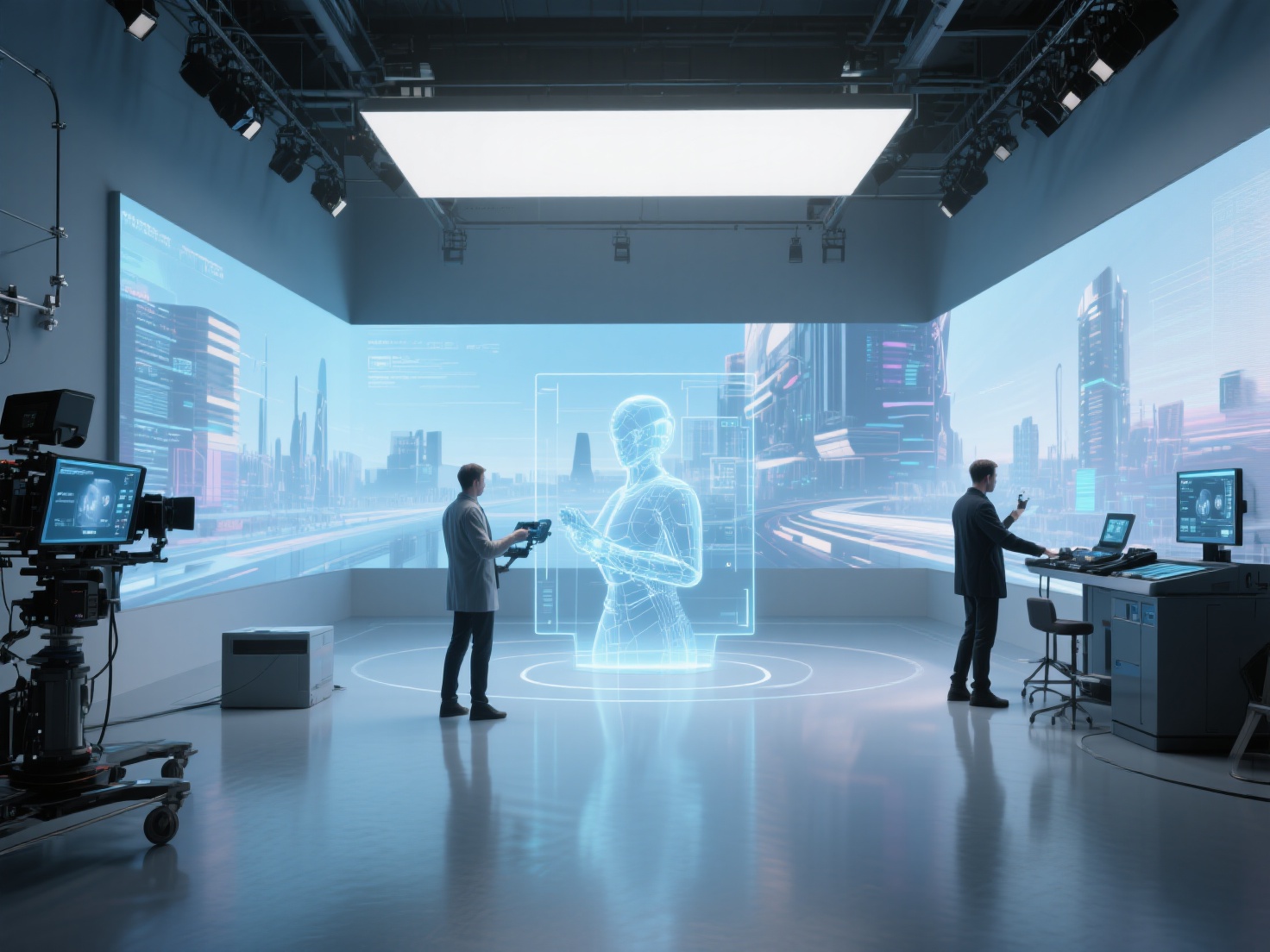
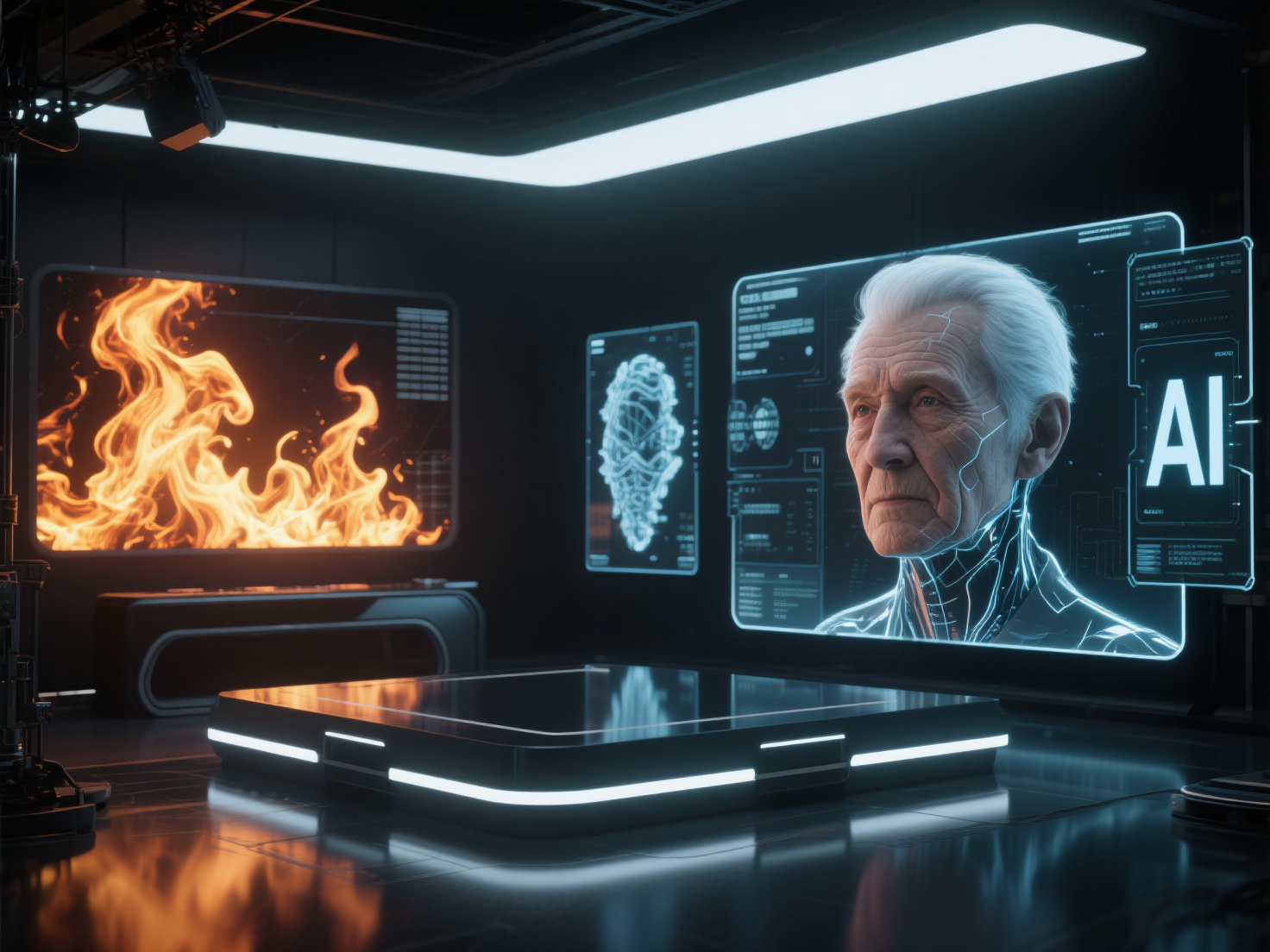
The visual effects industry has always been at the bleeding edge of technological innovation. However, the sheer amount of manual labor required to bring fantastical worlds to life has historically made high-end VFX the exclusive domain of blockbuster budgets. Fast forward to 2026, and the landscape has dramatically shifted. AI VFX is no longer a futuristic concept or a gimmicky experiment—it is the foundational backbone of modern post-production pipelines.
From indie films to massive studio franchises, artificial intelligence visual effects are accelerating workflows, slashing budgets, and empowering artists to focus on creative direction rather than tedious, repetitive tasks.
In this comprehensive guide, we will explore exactly how AI is reshaping the industry, dive into the core technologies driving AI film production, and provide actionable insights on integrating these powerful tools into your studio’s workflow.
What Is AI in Visual Effects (VFX)?
Artificial intelligence in visual effects refers to the use of machine learning algorithms, neural networks, and generative models to automate, enhance, and accelerate traditional post-production tasks.
Instead of relying solely on human artists to manually rotoscope frames, sculpt base meshes, or calculate complex fluid physics, AI systems learn from vast datasets of existing visual data. This allows them to predict, generate, and seamlessly manipulate pixels and 3D geometries in a fraction of the time. In 2026, AI is not replacing the artist; it is acting as an ultra-efficient digital assistant, capable of handling everything from AI 3D generation VFX to advanced de-aging.
Core Technologies Revolutionizing VFX Production in 2026
The integration of artificial intelligence into film production spans across multiple disciplines. Here are the core areas where AI is making the most significant impact today.
1. AI 3D Generation VFX: The End of Manual Polygon Pushing
Historically, creating background props, environmental scatter, or complex vehicle assets required weeks of meticulous modeling, UV unwrapping, and texturing. Today, AI 3D generation VFX has completely transformed this bottleneck.
Leading the charge in this space is Hitem3D, a next-generation AI-powered 3D model generator that has become indispensable for VFX artists. Built on proprietary Sparc3D (high precision) and Ultra3D (high efficiency) models, Hitem3D allows artists to upload a single 2D image—or multi-view images (2-4)—and instantly generate production-ready 3D assets.
For VFX pipelines, Hitem3D solves several critical industry pain points:
- Invisible Parts Reconstruction: Unlike early AI generators that only mapped the visible surface, Hitem3D intelligently reconstructs hidden and invisible structures beyond the camera’s view, ensuring full geometric accuracy.
- De-Lighted Textures: A massive headache for lighting artists is dealing with baked-in shadows on photo-scanned or AI-generated assets. Hitem3D features intelligent AI texturing, outputting 4K PBR-ready textures with De-Lighted processing. It removes baked-in lighting, giving compositors and lighters true, relightable materials that react perfectly to HDRI environments in Nuke, Maya, or Houdini.
- Production-Ready Topology: Supporting resolutions up to 1536³ Pro (up to 2M polygons), it delivers clean geometry with sharp edges. Models can be instantly exported in standard VFX formats like FBX, OBJ, USDZ, and GLB.
2. Automated Rotoscoping and Object Removal
Rotoscoping—the process of manually cutting out actors or objects frame-by-frame—has long been the most tedious job in the industry. In 2026, AI algorithms can instantly recognize human figures, vehicles, and complex foreground elements, generating pixel-perfect alpha mattes in seconds. Furthermore, AI object removal tools can seamlessly erase unwanted elements (like boom mics, wires, or even entire buildings) by intelligently synthesizing the background based on temporal data from surrounding frames.
3. Digital De-Aging and Face Replacement (Deepfakes)
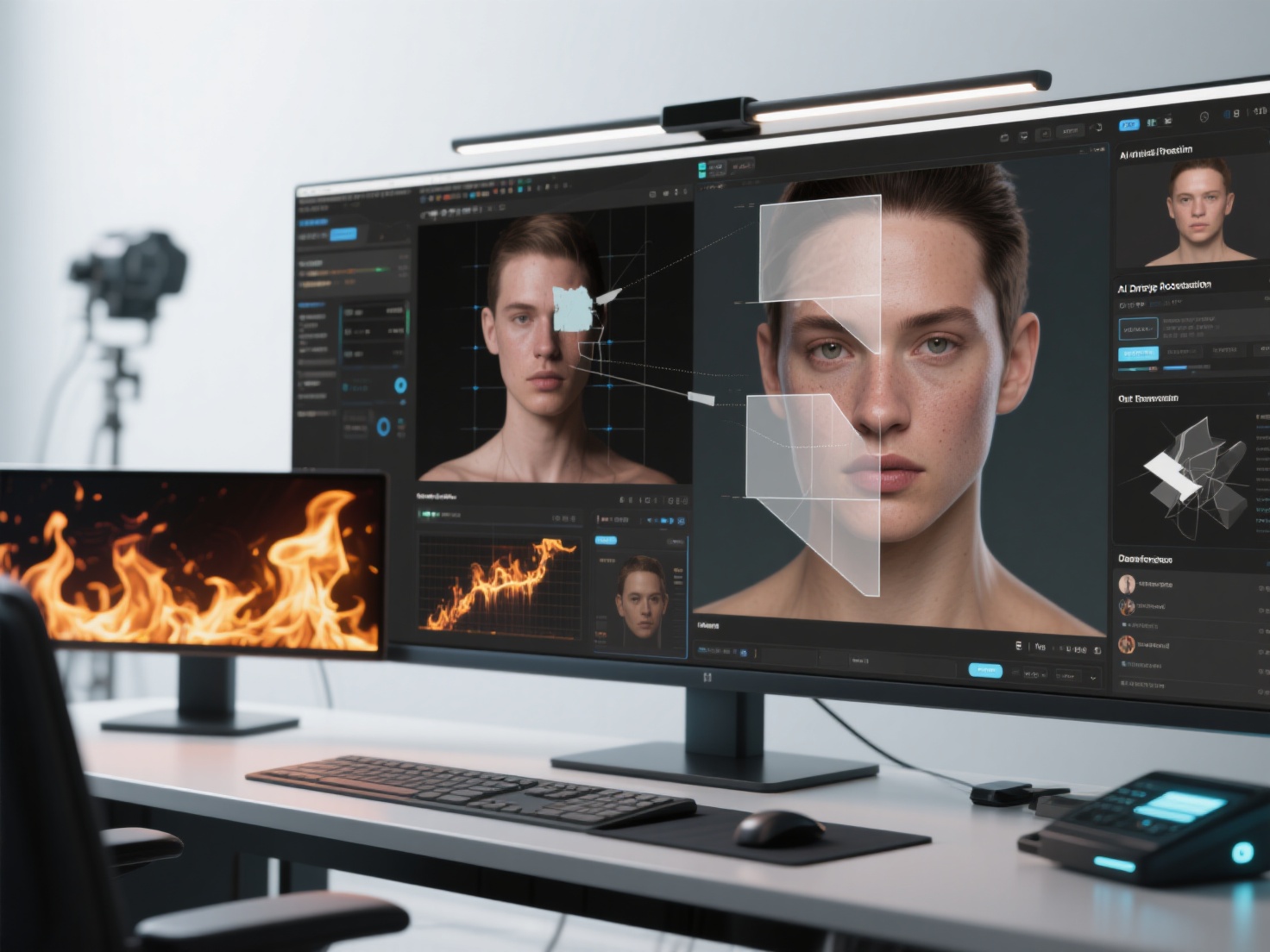
What once cost millions of dollars and required proprietary multi-camera rigs is now largely driven by AI. High-end deepfake technology has matured into a stable, production-ready tool. Neural networks can map the facial performance of an actor and seamlessly blend it with a younger version of their face, preserving micro-expressions and skin elasticity. This AI film production technique is heavily utilized in franchise prequels and stunt-double face replacements.
4. Generative AI for Background Environments
Matte painters and environment artists are now using generative AI to create massive, hyper-realistic backgrounds. By using text-to-image and text-to-video models, artists can rapidly iterate on concept art or generate 360-degree HDRIs for virtual production LED volumes. This allows directors to see near-final environments directly on set, drastically reducing post-production guesswork.
5. AI-Driven Physics Simulations
Simulating fire, water, smoke, and large-scale destruction traditionally required massive render farms and days of calculation time. AI-driven simulation solvers now use deep learning to predict fluid dynamics and particle behavior. This allows VFX artists to iterate on complex simulations in real-time, tweaking the art direction of an explosion or a tidal wave without waiting overnight for a render cache.
Applications: The Impact on VFX Studio Workflows and Job Roles
The widespread adoption of artificial intelligence visual effects has fundamentally altered how studios operate.
- Non-Linear Pipelines: Traditional VFX pipelines were highly linear (Concept -> Modeling -> Texturing -> Rigging -> Animation -> Lighting -> Compositing). AI allows for parallel workflows. For instance, a compositor can use a rough AI-generated 3D model to block out a shot while the 3D team refines the final asset.
- Democratization for Indie Studios: Small, independent VFX houses can now punch above their weight class. With tools like Hitem3D handling bulk 3D asset generation, a team of five can output the environmental scale that previously required a team of fifty.
- Evolution of Job Roles: The role of the “Junior Modeler” or “Roto Artist” is shifting toward “AI Technical Director” or “Asset Curator.” Artists are spending less time pushing vertices and more time directing AI tools, refining outputs, and focusing on the final aesthetic polish.
Best Practices for Integrating AI into Your VFX Pipeline
Adopting AI requires strategy. Here are the best practices for studios looking to modernize their workflows in 2026:
- Target Bottlenecks First: Don’t try to replace your entire pipeline overnight. Identify your biggest time-sinks—such as background asset modeling or wire removal—and introduce AI tools specifically for those tasks.
- Demand Production-Ready Outputs: Not all AI tools are built for high-end film. Ensure the tools you adopt support industry-standard formats. For 3D generation, prioritize platforms that offer FBX/USDZ exports and De-Lighted PBR textures, as these are non-negotiable for professional lighting and compositing.
- Maintain the “Human in the Loop”: AI is a powerful assistant, not an Art Director. Use AI to generate the 80% baseline, and rely on your highly skilled artists to manually refine the final 20%. The human touch is what separates acceptable VFX from award-winning VFX.
- Navigate Ethical and Legal Boundaries: In the realm of AI film production, copyright and likeness rights are paramount. Ensure your studio only uses AI tools trained on ethically sourced data, and always secure explicit legal consent before utilizing AI for face replacement or voice cloning.
Embracing the AI VFX Revolution
The year 2026 marks a turning point where AI VFX is seamlessly woven into the fabric of visual storytelling. By automating the mundane and accelerating the complex, artificial intelligence is granting artists the ultimate luxury: the time to be truly creative.
Whether it is utilizing neural networks for instant rotoscoping, or leveraging AI 3D generation VFX to populate massive digital environments, the studios that embrace these technologies are the ones that will define the future of cinema.
If you are looking to dramatically accelerate your 3D asset creation pipeline without sacrificing quality, Hitem3D is the ultimate solution. Trusted by creators in over 50 countries, our platform transforms 2D images into high-fidelity, production-ready 3D models. With our proprietary Invisible Parts technology, De-Lighted 4K PBR textures, and a generous Free Retry system that lets you regenerate results without wasting credits, Hitem3D is built for the demands of modern VFX.
Ready to revolutionize your 3D workflow?
Create For Free
Frequently Asked Questions (FAQ)
Will AI replace VFX artists?
No. AI is replacing tedious, repetitive tasks, not the artists themselves. AI empowers artists by acting as a highly efficient tool, allowing them to focus on creative problem-solving, art direction, and high-level visual polishing.
Can AI generate production-ready 3D models for film?
Yes. Next-generation platforms like Hitem3D are specifically designed for professional workflows. They can generate models with up to 2 million polygons (1536³ Pro resolution), reconstruct hidden geometry, and export in standard formats like USDZ, FBX, and OBJ.
What is a “De-Lighted” texture in AI 3D generation?
When AI generates a 3D model from a photo, it often bakes the original photograph’s shadows and highlights directly into the texture. A De-Lighted texture utilizes AI to intelligently remove these baked-in lighting details, resulting in a flat, neutral diffuse map. This is crucial for VFX, as it allows the 3D model to be accurately lit by the virtual environment of the film scene.
How does AI handle invisible or hidden parts of an object?
Traditional photogrammetry struggles with parts of an object that are hidden from the camera. Advanced AI models, such as Hitem3D’s Sparc3D, use predictive machine learning to intelligently infer and reconstruct the hidden geometry beyond the visible surfaces, ensuring a complete, fully watertight 3D model.