Every indie developer and game design student faces a critical crossroads before writing their first line of code: should you build a 2D or 3D game? This fundamental choice shapes your entire development journey, dictating everything from the software you use to the size of your team.
The debate of 2D vs 3D game design is not just about aesthetics; it is about resource management, workflow complexity, and the type of experience you want to deliver to your players. While 2D games often evoke nostalgia and offer tight, precise mechanics, 3D games push the boundaries of immersion and realistic exploration.
In this comprehensive guide, we will break down the complexities of a 2D game vs 3D game, compare their development pipelines, and provide actionable advice on choosing the game dimension that best fits your vision and budget.
What is 2D and 3D Game Design?
To capture the essence of these two distinct workflows, we must first define their core technical differences:
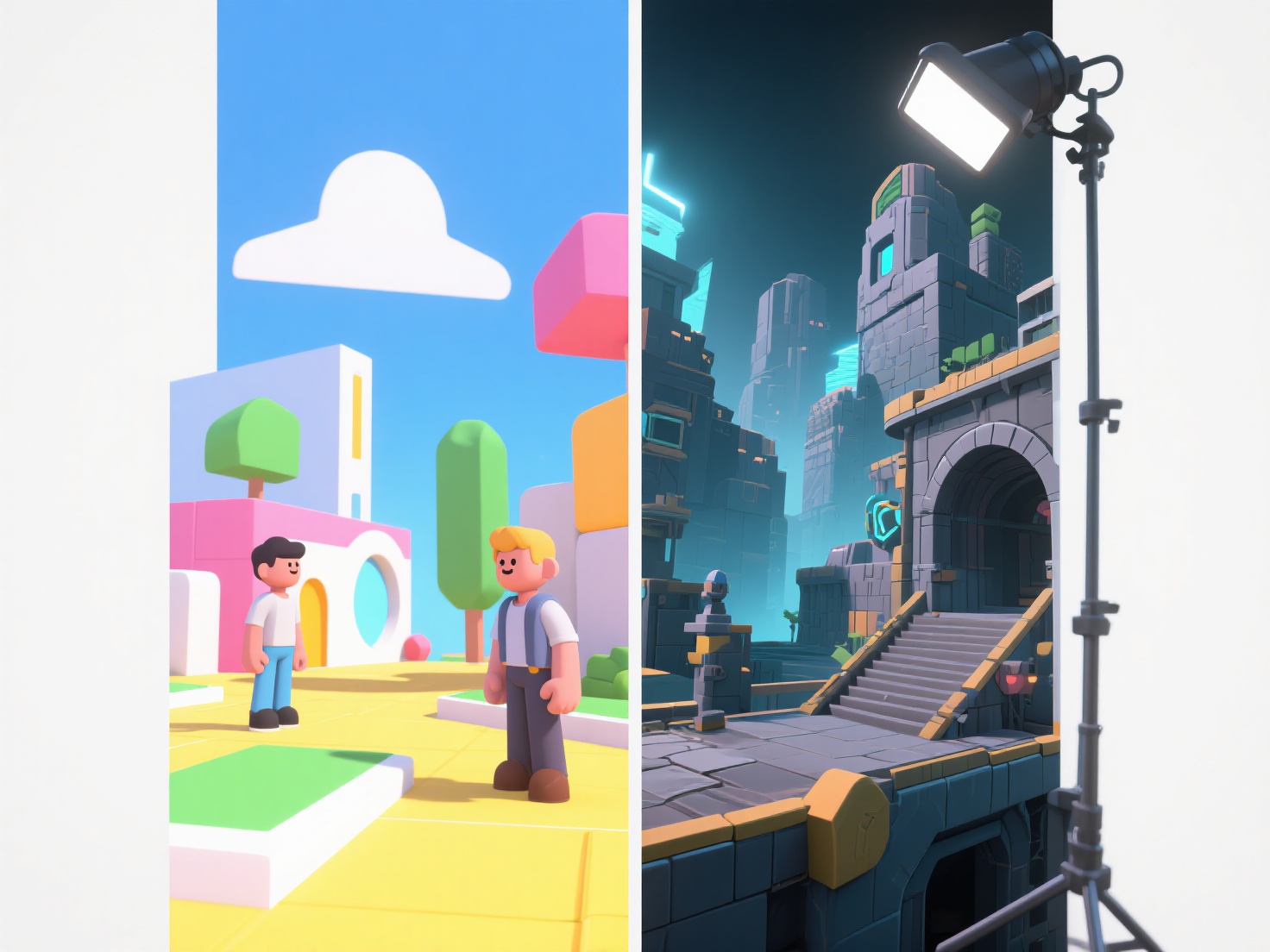
2D game design is the creation of video games in a flat, two-dimensional space where characters and environments only move along the X (horizontal) and Y (vertical) axes, relying on flat graphics like sprites, pixel art, or vector images.
3D game design is the process of building interactive worlds in a three-dimensional space, adding the Z (depth) axis. This approach utilizes polygonal meshes, rigged skeletons, and physically based rendering (PBR) textures to create fully explorable, voluminous environments with dynamic lighting and physics.
Key Differences Between 2D and 3D Game Design
Understanding the distinct requirements of 2D or 3D game development is essential for properly scoping your project. Here is a deep dive into the core differences.
Art Pipeline and Complexity
The most significant divergence lies in how visual assets are created. In a 2D workflow, artists draw flat images. Character animations require either drawing every single frame by hand (traditional animation) or manipulating flat body parts using 2D skeletal software like Spine.
In a 3D workflow, the pipeline is far more complex. A single character requires 3D modeling, UV mapping, texturing, rigging (creating a skeleton), and animating. This multi-step process historically demanded specialized skills across various software ecosystems.
Development Time and Cost
Because of the simpler art pipeline, 2D games are generally faster and cheaper to produce, making them a favorite for solo developers and small indie studios. You can often rapidly prototype a 2D level in a single afternoon.
Conversely, 3D game development requires more time per asset. Building a fully realized 3D city with realistic textures, lighting, and physics can quickly inflate a budget. However, as we will discuss later, modern AI tools are drastically reducing these costs.
Required Skills and Game Engines
The technical skills required vary vastly. A 2D developer needs strong fundamental drawing skills, an understanding of color theory, and mastery of sprite creation. Popular engines include GameMaker Studio, Godot, and the 2D module of Unity.
A 3D developer needs a strong grasp of spatial awareness, 3D math (vectors and quaternions), and camera behavior. They must master complex software like Blender or Maya. Engines like Unreal Engine and Unity 3D dominate this space due to their robust physics and lighting systems.
Player Experience and Immersion
2D games often excel at delivering tight, highly responsive controls, making them ideal for precision platformers, fighting games, and puzzle games. The camera is fixed, meaning the developer maintains complete control over what the player sees.
3D games offer unparalleled immersion. Players can freely rotate the camera, explore vast open worlds, and interact with objects from multiple angles. This depth adds realism but also introduces challenges, such as ensuring the camera doesn’t clip through walls or obscure the player’s view.
2D vs 3D Game Design: At-a-Glance Comparison
To help you weigh your options, here is a quick comparison of the two dimensions:
| Feature | 2D Game Design | 3D Game Design |
|---|---|---|
| Movement Axes | X (Left/Right), Y (Up/Down) | X, Y, and Z (Depth/Forward/Backward) |
| Visual Assets | Sprites, Pixel Art, Vector Graphics | Polygonal Models, PBR Textures, Rigs |
| Camera Control | Fixed (Orthographic) | Dynamic, Player-Controlled (Perspective) |
| Dev Time/Cost | Generally lower | Generally higher (unless utilizing AI tools) |
| Ideal Genres | Platformers, Metroidvanias, Puzzles | Open-world RPGs, FPS, Simulations |
| Team Size | Viable for solo devs / small teams | Usually requires larger, specialized teams |
The Hybrid Approach: Exploring 2.5D Games
If you are torn between the two, you might consider the 2.5D hybrid approach. This style bridges the gap by mixing 2D and 3D elements.
There are two common ways to achieve this:
3D Graphics on a 2D Plane: The game is built using fully 3D models and environments, but player movement is restricted to a 2D plane (e.g., Super Smash Bros or Inside).
2D Sprites in a 3D World: Flat 2D character sprites are placed within a deeply layered 3D environment, often utilizing advanced lighting (e.g., Octopath Traveler or Don’t Starve).
2.5D is an excellent compromise, offering the visual depth of 3D while maintaining the straightforward mechanics and level design of 2D.
How to Choose the Right Dimension for Your Project
Making the final call between 2D vs 3D game design requires an honest assessment of your current situation. Here is how to decide based on practical factors.
Based on Team Size and Budget
If you are a solo developer working with a shoestring budget and limited time, 2D is often the safest bet. You can manage the entire pipeline yourself, from drawing sprite sheets to coding 2D physics.
If you have a slightly larger team, a higher budget, or access to modern asset-generation technology, 3D becomes highly viable. 3D games often have a higher perceived value in the marketplace, which can aid in monetization and premium pricing.
Based on Game Genre
Your genre will heavily dictate your dimension:
- Choose 2D for: Metroidvanias, fast-paced bullet hells, cozy farming simulators, and card battlers.
- Choose 3D for: First-person shooters (FPS), immersive role-playing games (RPGs), racing simulators, and atmospheric horror games.
Best Practices for Transitioning to 3D
If you decide that your vision requires a 3D world, the traditional barriers to entry—namely the grueling, time-consuming 3D modeling process—no longer have to hold you back. Here are the best practices for modern 3D game design.
Start with Greyboxing: Before investing time in high-quality assets, build your levels using basic geometric shapes (cubes, cylinders) to test gameplay and scale.
Optimize Polygon Counts: Keep your models optimized for performance. Use high-poly models for main characters and lower-poly models for background props.
Leverage AI for Asset Generation: The biggest bottleneck in 2D or 3D game development is asset creation. Instead of spending days manually modeling every barrel, weapon, and background prop, modern indie developers are turning to AI.
This is where integrating a tool like Hitem3D completely changes your workflow. As a next-generation AI-powered 3D model generator, Hitem3D allows developers to upload simple 2D concept art and instantly generate production-ready 3D assets.
Powered by the Sparc3D (high precision) and Ultra3D (high efficiency) models, Hitem3D excels in invisible parts reconstruction, intelligently generating the hidden backsides of objects—a critical feature when creating game assets that players will walk around. Furthermore, it generates 4K PBR-ready textures utilizing De-Lighted processing. This intelligently removes baked-in lighting from the AI generation, leaving you with true, relightable materials that react perfectly to the dynamic lighting inside Unity or Unreal Engine.
With a seamless export to formats like FBX, OBJ, and GLB, and a Free Retry system that lets you tweak generations without wasting credits, Hitem3D acts as your personal 3D art department.
Conclusion: Making the Right Choice for Your Next Game
The choice between 2D vs 3D game design is a defining moment for your project. 2D offers a streamlined, cost-effective pipeline perfect for tight gameplay mechanics and solo developers. Meanwhile, 3D provides vast, immersive worlds and dynamic realism that can captivate players for hundreds of hours.
Ultimately, choosing the game dimension comes down to your genre, budget, and the tools at your disposal. Today, creating a 3D game is more accessible than ever before. With the rapid advancement of AI, the steep learning curve and massive time investment previously required for 3D modeling have been drastically reduced.
Ready to populate your indie game with high-fidelity 3D assets without the weeks of manual modeling? Empower your development workflow with up to 1536³ Pro resolution geometry and game-engine-ready exports.
Frequently Asked Questions (FAQ)
Q1: Which is more profitable, a 2D or 3D game?
Profitability depends heavily on marketing, gameplay quality, and niche rather than just the dimension. However, 3D games often command higher premium price points on platforms like Steam due to a higher perceived production value.
Q2: Can I make a 3D game as a solo developer?
Absolutely. While traditionally difficult, solo developers can now successfully build 3D games by leveraging asset stores, visual scripting, and AI 3D asset generators like Hitem3D to significantly speed up the art pipeline.
Q3: Is 2D game development dying?
Not at all. The indie game scene continues to see massive success with 2D games (e.g., Hollow Knight, Celeste, Stardew Valley). 2D is a stylistic choice that remains incredibly popular for specific genres and aesthetics.
Q4: Do I need to know how to draw to make a 3D game?
No, drawing skills are not strictly required for 3D development. While concept art helps, 3D relies more on spatial manipulation, sculpting, and understanding form. You can also generate 3D models directly from existing images using AI tools, bypassing manual drawing entirely.